
From purpose to action: introducing our Cascading Communications Strategy
Most communications plans start with channels and content. Ours starts with your strategy, so everything you say links back to what your organisation is trying to achieve.
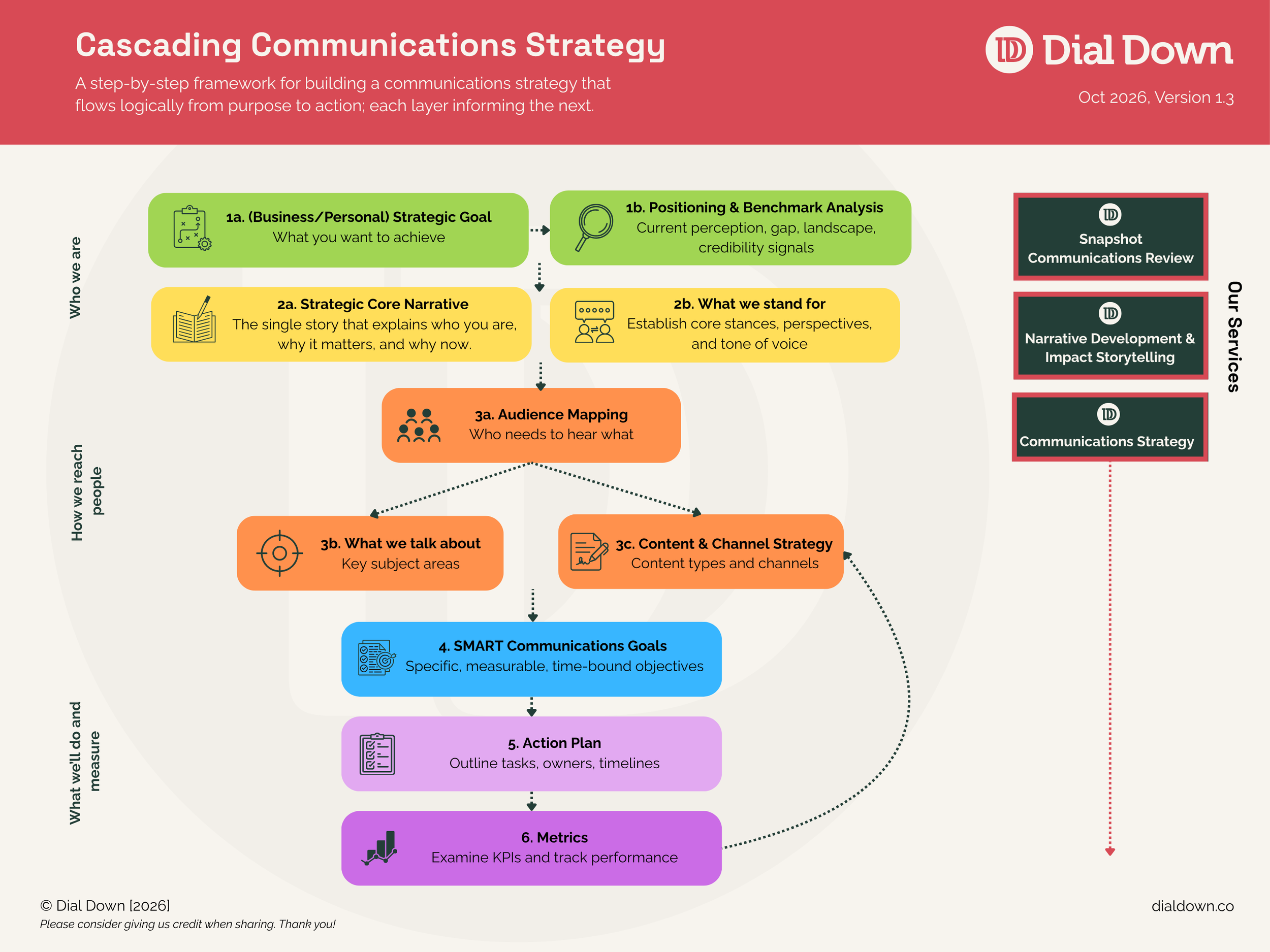
Dial Down - Cascading Communications Strategy, V1.3 (October 2026)
One cooperative we worked with this year captured a challenge that many others face: “Sadly, our publicity doesn’t match the work we actually do.” That gap is where most of our projects begin. The work is already there; it just isn't being told clearly yet.
The usual response is to do more. Post more often, start a newsletter, try a new platform. But more content rarely fixes it, because the problem usually sits further upstream. Many communications plans jump straight to channels, calendars and posts before anyone has asked the quieter questions:
What are we trying to achieve? How are we seen today? What do we stand for? Who needs to hear from us, and what do they need to hear?
That's why we built our Cascading Communications Strategy. It's a step-by-step framework that flows from purpose to action, with each layer informing the next. By the time you reach a content plan, every post links back to what your organisation is trying to achieve.
We've used it this year to build communications strategies with women's cooperatives across Türkiye and other purpose-driven teams. Before Dial Down, we each used versions of this approach in our previous roles. This is the first time we're sharing it publicly.
The cascade has three parts, each named from your organisation's point of view:
Who we are: the fixed core
How we reach people: the part that changes
What we'll do and measure: where strategy becomes action
Who we are
This part doesn't change by audience or channel, so it comes first.
1a. Strategic goal. What you want to achieve, taken from your organisational strategy or, if you're an individual, your personal goals. It isn't a communications goal yet. It's the destination, and communications exists to serve it, not the other way round.
1b. Positioning and benchmark analysis. An honest look at where you are now. How are you seen today, and by whom? What's the gap between that and where you want to be? Who else works in your space, and what are they saying? Which credibility signals does your audience trust: awards, certifications, partnerships, numbers?
This step often changes the brief. With several of the cooperatives we worked with, the gap wasn't quality or proof. The products, awards and shelf space were already there. What was missing was recognition beyond their own region. That's a different problem from "we need more followers", and it needs a different plan.
2a. Strategic core narrative. The single story that explains who you are, why it matters and why now. You'll adapt it for different audiences and channels, but it's the version you always come back to.
2b. What we stand for. Three to five values that shape how you work and how you see the world. Make them specific. "Sustainability" could belong to anyone. "Nothing wasted" belongs to you, and it can run through a post about production, a pitch to a buyer and a report to a funder. A value isn't a topic. It runs through everything you talk about.
You don't need to invent them. Most organisations already have values, written down or not. In our cooperative strategies, we built on the values the women already named as their own.
Your tone of voice comes from here too. Once your values are clear, tone is how they sound.
We put this before audiences on purpose. If you map audiences first, it's tempting to shape your values around what each group wants to hear. That's how organisations end up sounding different everywhere and memorable nowhere. Your audiences should change what you emphasise, not who you are.
How we reach people
This is the part that changes. Same core, different conversations.
3a. Audience mapping. Who needs to hear what. Most strategies have a primary audience, a secondary audience and amplifiers: the partners, media and networks who can carry your story further. For each one, ask which part of your story matters most to them, and how to say it in their terms.
3b. What we talk about. Two to four topics you keep coming back to. Your values shape how you talk. Topics are what you talk about, and each one takes its character from what you stand for.
3c. Content and channel strategy. What you make, and where it lives. We tend to use four content types:
Inform: explains who you are and what you do, so people can trust you
Inspire: tells a story and makes people feel something
Involve: shows the people and the process, so your audience feels part of it
Invite: asks for one clear next step
Channels follow your audiences, not trends. In one cooperative's strategy, Instagram was for reaching the public and LinkedIn was for the corporate buyers who sign off on orders.
What we'll do and measure
This is where strategy becomes action. The three steps work together, but they aren't the same thing.
4. SMART communications goals. Specific, measurable and time-bound. Each one should serve your strategic goal and close a gap you found in 1b. The test: can you put a number and a deadline on it? If not, it's still a direction rather than a goal.
5. Action plan. The tasks, owners and timelines that get you there. One lesson from our work: name one person who owns it. Even if it's part-time, someone needs to gather the stories and keep things moving.
6. Metrics. How you know it's working. Measure your goals, not your platforms. Saves and shares often tell you more than follower count. A quick check each month and a fuller review each quarter is usually enough.
Goals come late on purpose. Your strategic goal steers everything from the top, but specific targets are more realistic once you know who you're reaching and what you'll make. Set them too early and they tend to describe hopes rather than plans.
It also helps to keep the three apart. "Make a product sheet" is an action. "Open ten new buyer conversations in six months" is a goal. Sheets sent and conversations opened are how you measure it. If you merge them, it's hard to tell whether busy work is moving anything.
Then the cascade loops back. What your metrics show feeds into what you make next, so the strategy keeps learning instead of sitting in a drawer.
Where to start
You don't need to do it all at once. The biggest gains usually come from the top of the cascade: being clear on what your organisation is trying to achieve, taking an honest look at where you stand and knowing the story of who you are. Everything below gets easier from there.
Clarity starts when you slow down.
Use the framework and share the diagram. Please credit Dial Down when you do.
Want to explore this with your team? Each part of the cascade connects to how we work with clients. Our Snapshot Communications Review looks at where you are now. Impact Storytelling & Narrative Development shapes your core story and what you stand for. A full Communications Strategy takes you through the whole cascade, from goal to metrics.
Explore our services or get in touch at hello@dialdown.co.
Ready to dial it down?
