
What no woman can do alone: Kırıkhan Women’s Cooperative
How fifteen women in Kırıkhan, Hatay, are turning the region's black carrot into something whose value finally stays in Kırıkhan — and proving, as Nermin Özer puts it, that a cooperative is really just ‘imece’, the old Anatolian tradition of collective work, institutionalised.
On the table in the main room, Nermin Özer sets out a recent product she has developed: a fine, deep-violet flour milled from black carrots. Sherbet, vinegar, crackers — those she describes rather than serves, a range still taking shape around the same crop. A month ago, none of it existed. The black carrot (siyah havuç) sits at the heart of it all, one of Kırıkhan's quiet treasures. It produces a natural pigment, its rich in antioxidants, and has been prized for centuries; and yet, until recently, almost none of that worth stayed here. "Bizim ürün aslında o kadar değerli ki," Nermin says, "ama katma değeri sıfır. Çünkü işlenmiyor." Our product is so valuable, but its added value is zero, because no one processes it. The raw crop leaves the district for next to nothing; someone far away turns it into colour and sells it for a hundred times more.
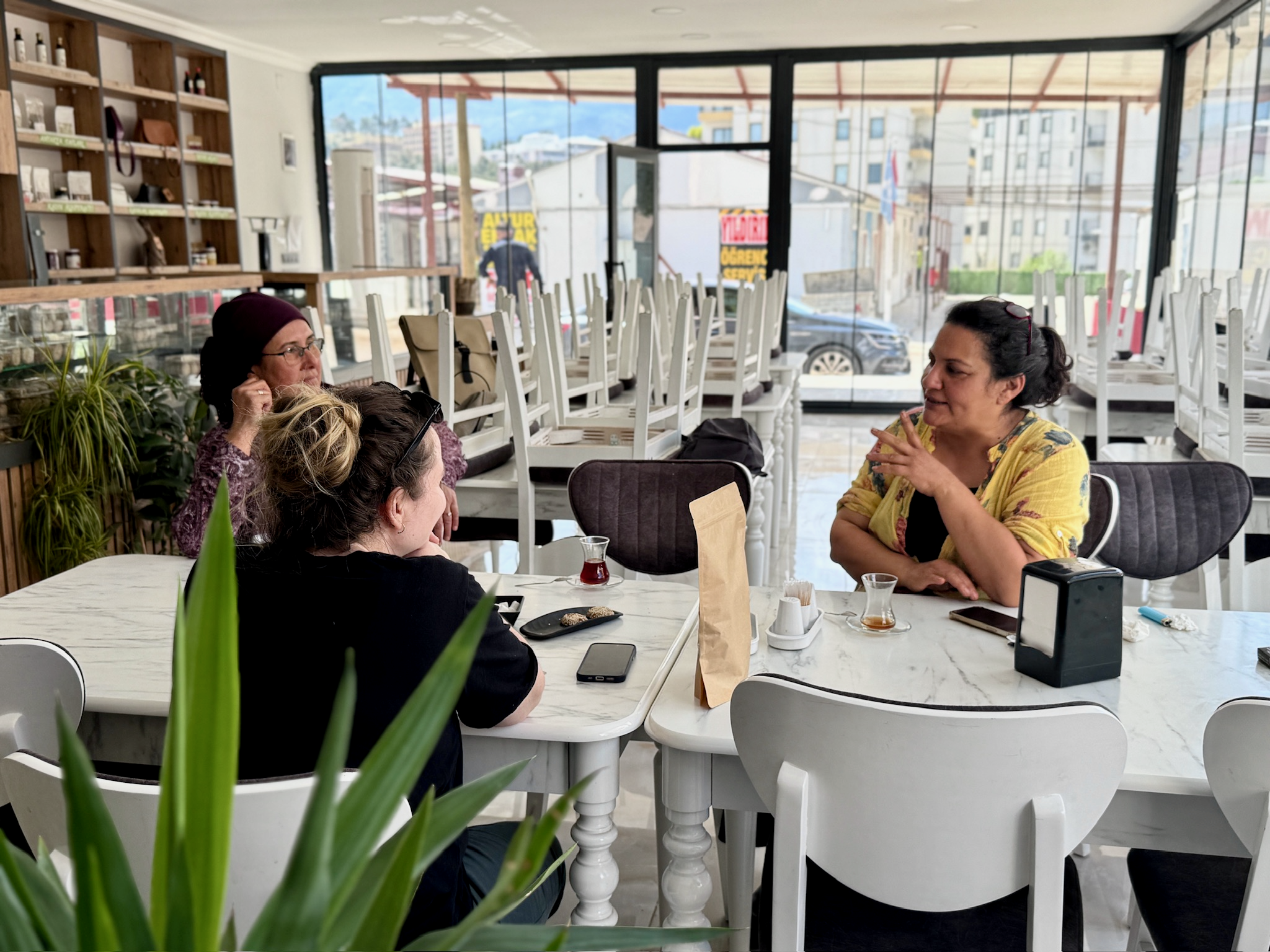
Inside Kırıkhan Women’s Cooperative in discussion with Chair Nermin Özer (right) and co-founder Songül Haklı (left).
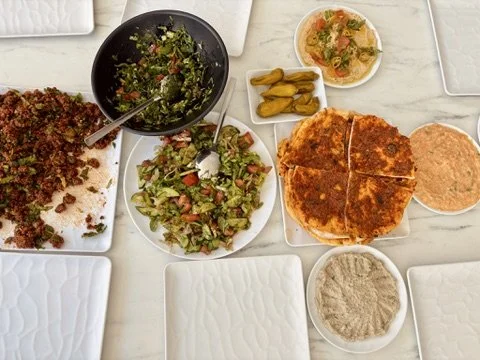
Selection of foods prepared for us by the women of Kırıkhan Women’s Cooperative: Olive salad with Hatay zahter, pepper bread, mütebbel, carrot with salted yoghurt, humus, and Hatay bulgur salad (kısır)
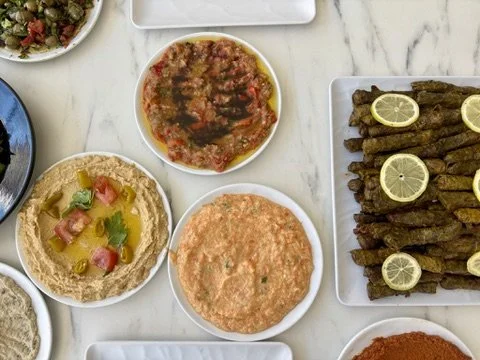
Selection of foods prepared for us by the women of Kırıkhan Women’s Cooperative: Grapvine wrap (sarma), hummus, eggplant dip
What a single farmer cannot change, a cooperative can. Ask Nermin what a cooperative really is, and she puts it plainly: "Kooperatifçilik aslında yardımlaşmanın kurumsallaşmış hali" — it is simply imece, made to last. One of those words that exists only in Turkish, imece is Anatolia's age-old tradition of collective work: a whole village turning out, willingly and as equals, to bring in a harvest or raise a house no single household could manage alone. One woman cannot buy the machine, or fill an order of a hundred jars. Fifteen women, each making her own goods under one roof, can. Closing that gap, together, is the whole point.
Grown here, valued elsewhere
Kırıkhan sits in Hatay, on Türkiye's southern edge near the Syrian border — carrot and melon country, with a long agricultural memory. The district holds three geographical-indication registrations of its own: the Kırıkhan carrot (Kırıkhan Havucu), the black carrot (Kırıkhan Siyah Havucu) and the Kırıkhan melon (Kırıkhan Kavunu). The black carrot is the quiet star: its deep colour comes from anthocyanins — a natural pigment prized by the food industry — and it is rich in antioxidants long valued for supporting the blood and the liver. Yet most of it still leaves Kırıkhan raw, its real worth captured by processors far from the fields. It is also a region still rebuilding after the February 2023 earthquakes, and one long shaped by movement.
Hatay is known for its hospitality, and Nermin feels both sides of it deeply: that her own people are not refugees in their own country, whatever the quake made them feel, and that the displaced families the region has taken in deserve a genuine welcome.
Seven women, then fifteen
The Sınırlı Sorumlu Kırıkhan Kadın Girişimi Üretim ve İşletme Kooperatifi was founded in 2021 by seven women who were out of work, and has grown to fifteen members — one of 30+ women's cooperatives in a province that, despite losing so much, ranks among Türkiye's busiest for them. Nermin, forty-nine and a mother of two who has lived in Kırıkhan her whole life, leads it. They began, as she tells it, "damdan düşer gibi" — like falling off a roof: with little idea of what they were doing and every intention of learning it the hard way. In those first days that meant whole nights out in the fields, taking turns to water the crop and one another under a punishing sun, with nothing to eat but the tomatoes growing around them. She tells it as comedy more than hardship but it is also the plainest measure of how much they wanted this.
The logic she describes is what holds the work together: no single woman could carry the cost or the orders alone, but pooled, small contributions become a machine, a cold store, a shared shopfront. Among the fifteen is a woman who came to the region as a refugee and now works alongside the rest as an equal, paid for her labour, counted as one of the whole. It is the welcome Nermin talks about, made real — not charity, but work, a fair wage, and an equal share of what they build together.
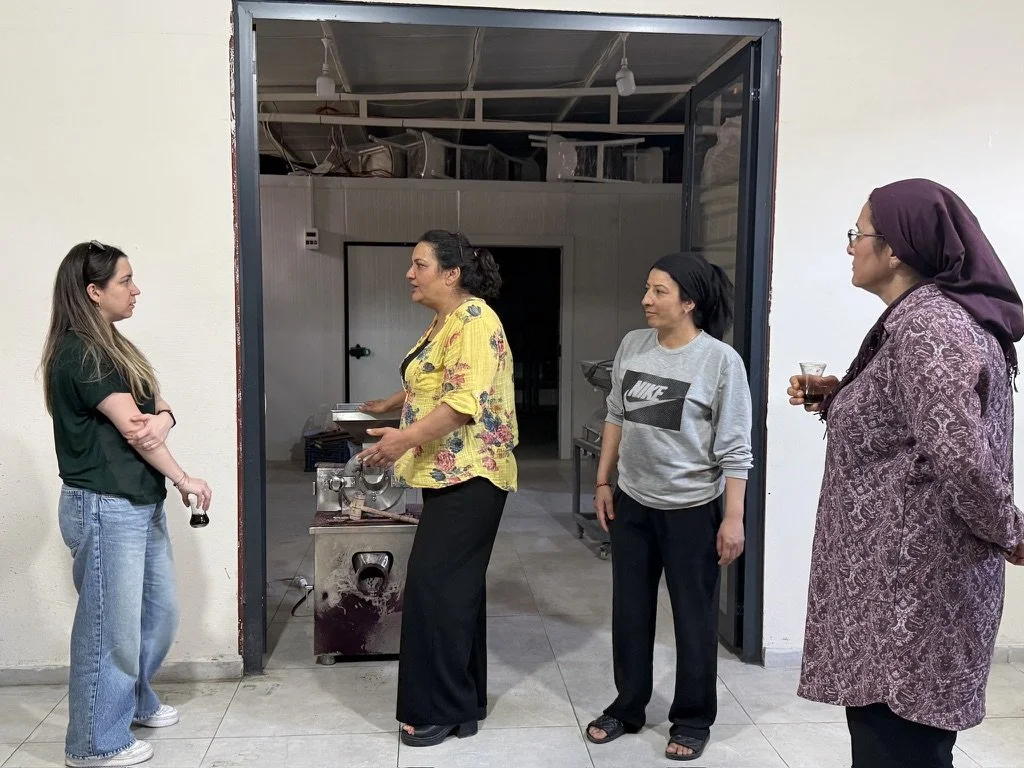
Aylin Yardımcı, Nermin Özer, Latife Hannen, Songül Haklı (From left to right)
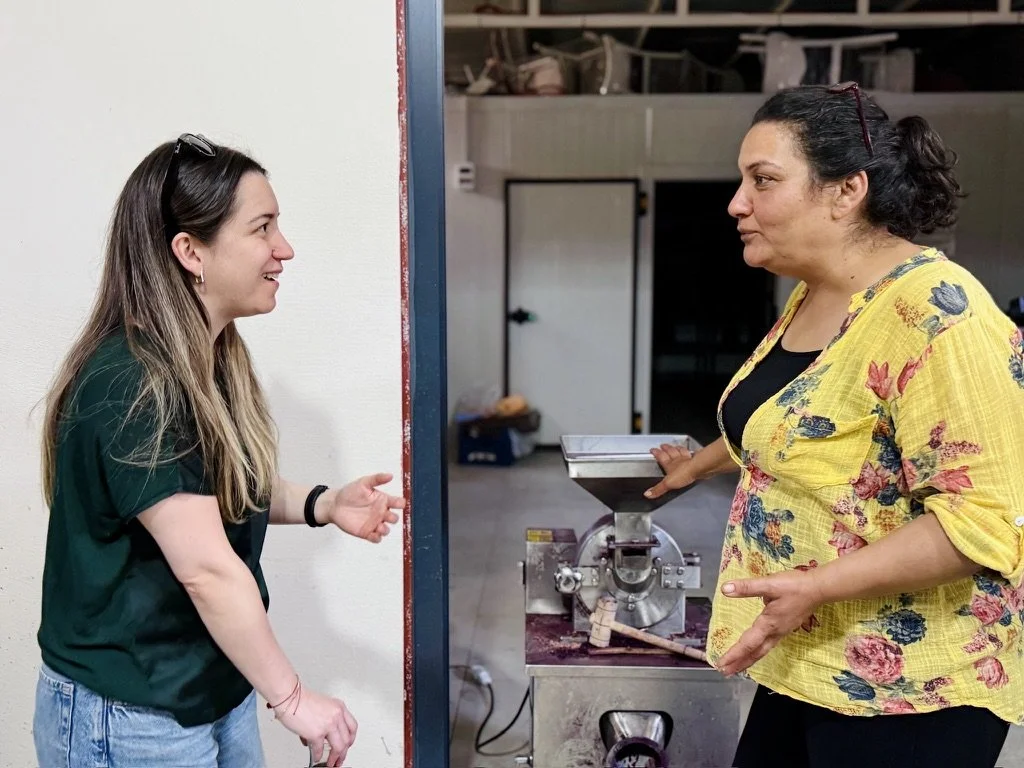
Nermin Özer talking to us about one of the machines they procured thanks to the ENHANCER project
What they make — and what they won't
From a 350-square-metre facility with cold storage, drying and an industrial oven, the women now produce one and a half to two tonnes a day, blending their grandmothers' recipes with the precision of food engineers. In a two-week sprint with a visiting food engineer and chef, they developed a handful of genuinely new products: black-carrot sherbet, vinegar, and a flour milled for cakes and crackers, dried gluten-free to hold its colour and nutrients. A kan dut (mulberry) syrup from an endemic plant is still fermenting, and a pickled peanut — fıstık turşusu — launches soon, and is, we can confirm, dangerously moreish.
The new range sits alongside the things the women have long made by hand: goat's-milk tuzlu yoğurt, a geographically protected Hatay delicacy good in soups, at breakfast or as a spread; Hatay olives and olive oil; fruit pestil; and kömbe, the spiced pastry that turns up on tables across Hatay.
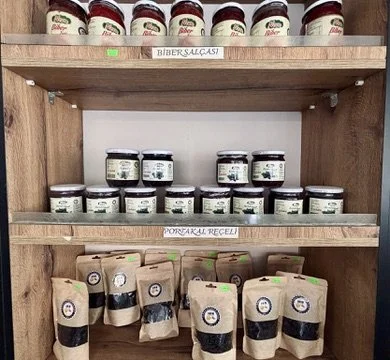
A range of their products ranging from plum pulp, jams, tomato and pepper pastes, mulberry syrup, and more
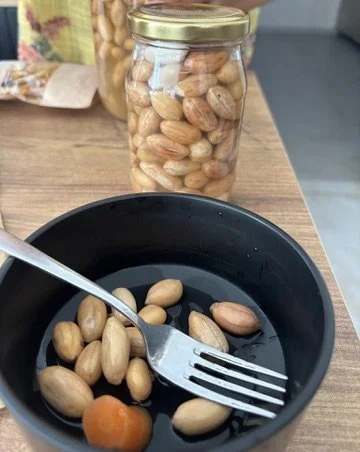
Pickled Peanut - a product launching soon
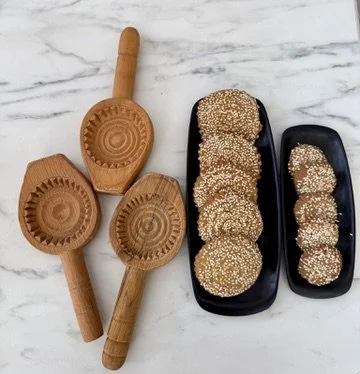
Kömbe - a 12 spiced cookie from Hatay
What sets them apart, though, is as much what they leave out. They stay clear of the big supermarket supply chains because those shelves, in practice, ask for the preservatives and shortcuts they won't use: lemon salt in place of real lemon juice, three per cent salt instead of the proper ten, a thickened imitation in place of tomato paste that cooks down and loses its water. The reason is less strategy than conviction. And it is more than a claim: independent lab analyses, for nutritional content and for pesticide and toxin residues, stand behind what they say about their food.
"We see all the children of this country as our own." — Nermin Özer
It is why they are uncompromising about sugar, additives and colour, and why, she says, the rising rates of diabetes, cholesterol and cancer in children are never far from their minds.
That resolve was tested at the worst possible moment. When the earthquakes hit, the cooperative lost most of its stock and moved production more than once. One member was trapped under rubble for hours; the morning after she was pulled free, her first words were not about herself but about what the women had made together — "Abla, ürünlerimiz… emek emek yaptık." — Sister, our products… we poured such labour into them.
Despite everything, they rebuilt, and kept going.
Where ENHANCER comes in
The women set the direction; the ENHANCER project helped them move faster along it. They wrote their own application and used the support to fit out their facility with the cold storage and the industrial drying oven now central to the line: the equipment that lets fragile fruit and carrot hold their colour and goodness, turning a raw harvest into something sellable. As Nermin says, "Birinin yardımıyla ayağa kalkamazsınız" — you can only get so far on someone else's help. Their food, in fact, already travels further than their name. Chefs in Istanbul cook with their salted yoghurt — Murat Kazdal among them, and the kitchen at Apartıman in Yeniköy — the products sell online and through the Hayat Hatay marketplace, and they turned up at a Galataport pop-up in Istanbul in December 2024.
What the cooperative is reaching for next is recognition that finally catches up with the food: the brand, the recipe content and the channels that let people discover these products, and learn how to use them.
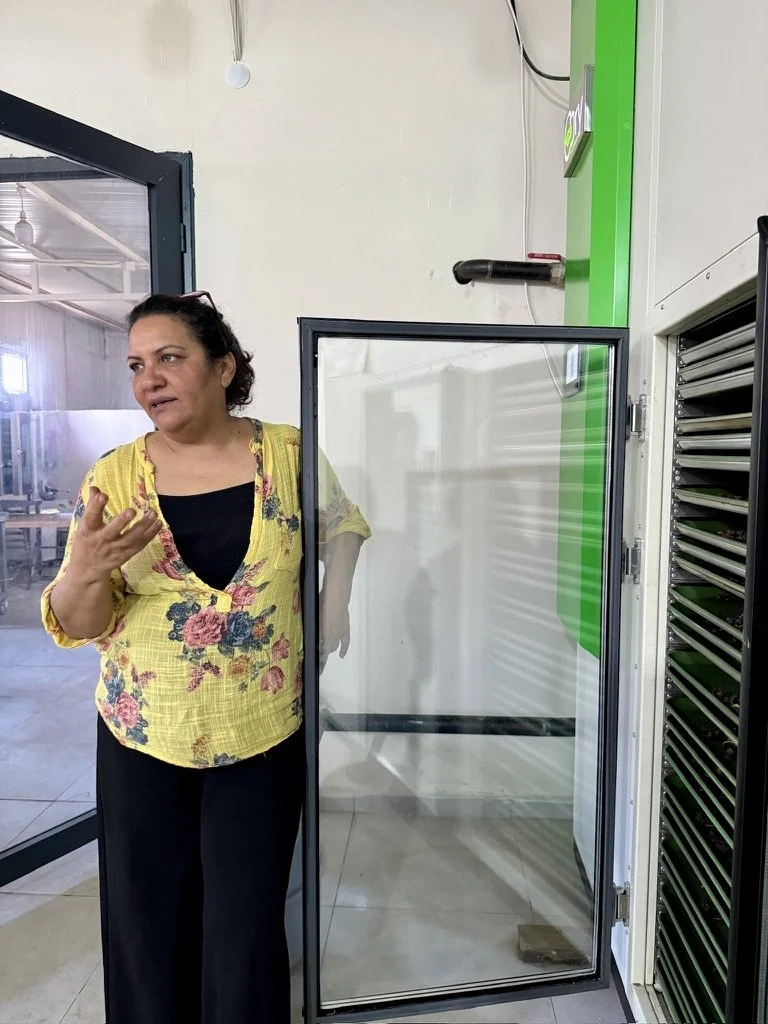
Nermin Özer showing us one of the new drying machines procured thanks to the ENHANCER project
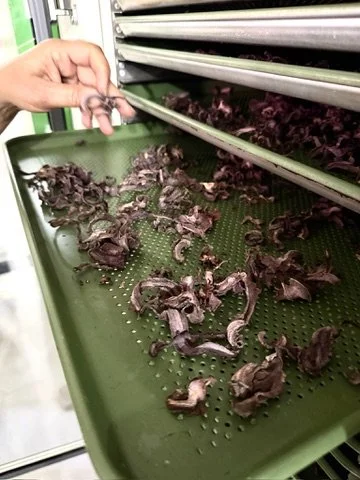
Dried black carrot
What comes next
Nermin still remembers an international buyer telling her that the one thing they took from Türkiye was sumac. "Ben çok üzülmüştüm," she says, it saddened me deeply. Her answer was the table itself — proof that the country, and her own district, has far more to offer than a single commodity spice. She wants Kırıkhan's black carrot known nationally and abroad, the cooperative scaling in stages, and — just as importantly — becoming a model others can follow. That part is already underway: rather than guard what they have learned, the women share raw materials and know-how with neighbouring cooperatives, treating them as partners rather than rivals. The point is proof that a region's own specialities can be made into something high-value at home, rather than sold off cheap.
What began like falling off a roof has become Nermin's own definition of a cooperative, made real: not the machine or the order one woman could never manage alone, but fifteen women, each making her own under one roof, keeping a district's worth where it grows. None of it was built alone, and that is the main story.
With thanks
We owe a great deal to the women of the Kırıkhan cooperative, who opened their doors to us — their workshop, their kitchen, and a story they are still writing — and who fed us generously from a table they had made themselves: mezes, sarma and an olive salad bright with zahter (and much more!). We are grateful most of all to Nermin Özer, whose clarity and conviction run through every line of this piece, and to Songül Haklı and Latife Hannen, who welcomed us on the day and built this work alongside her. We remember, too, those Kırıkhan lost in the earthquakes of 2023.
Thanks for showing us what imece really means.
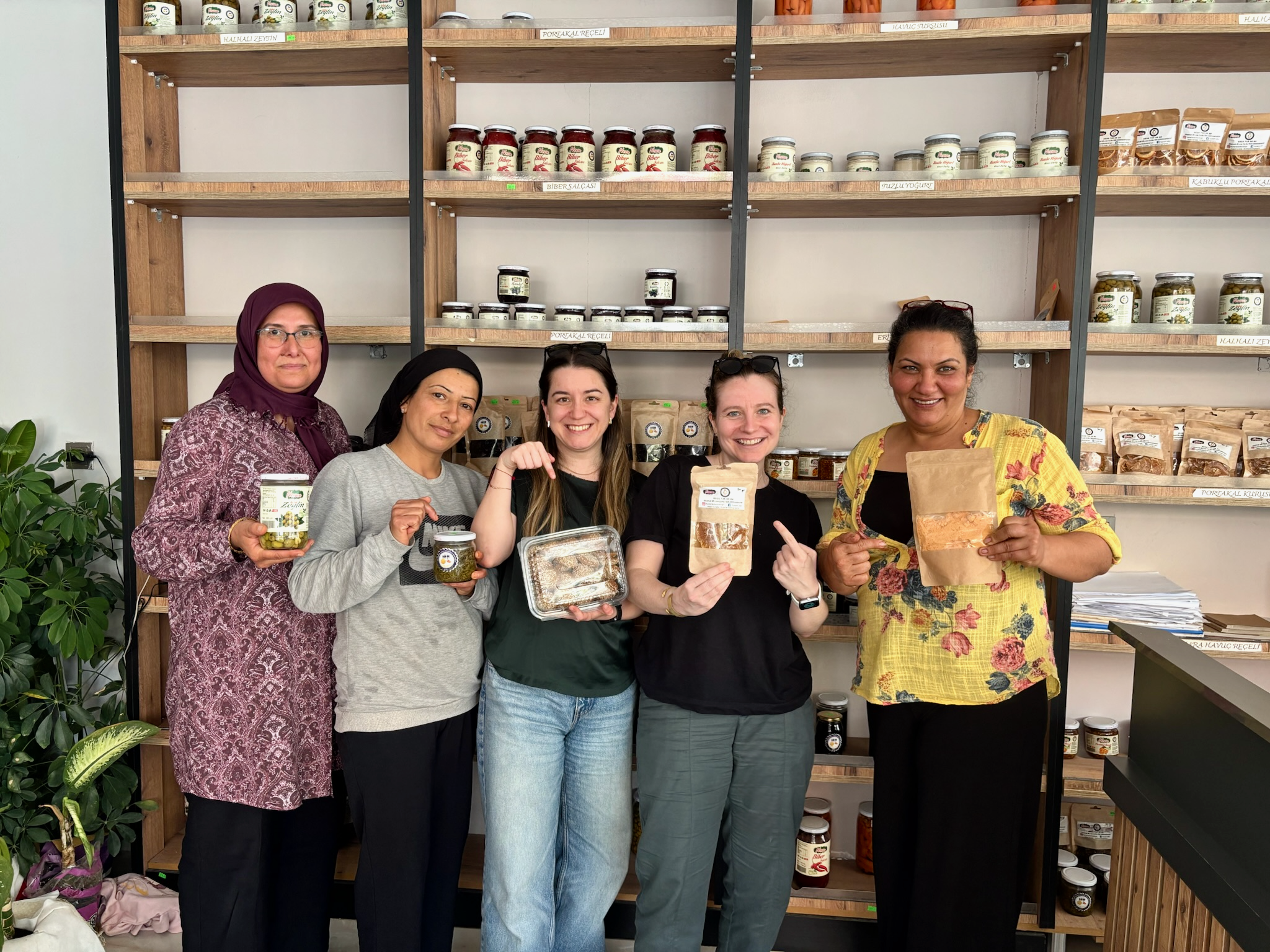
Songül Haklı, Latife Hannen, Aylin Yardımcı, Melissa Clissold, Nermin Özer (From left to right) at Kırıkhan cooperative showing off their products
Where to find them
You can follow the Kırıkhan cooperative and find their products online:
Website: https://www.kirikhankadinkoop.com/
Instagram: @kirikhankadinkoop
This story was created as part of the Enhancement of Entrepreneurship Capacities for Sustainable Socio-Economic Integration (ENHANCER) project, which is funded by the European Union and implemented by the International Centre for Migration Policy Development (ICMPD) in collaboration with the Directorate General of Development Agencies under the Ministry of Industry and Technology of the Republic of Türkiye.
